
What Is The Significance Of Palm Sunday?
Palm Sunday and the Fulfillment of Old Testament Prophecy (KJV)
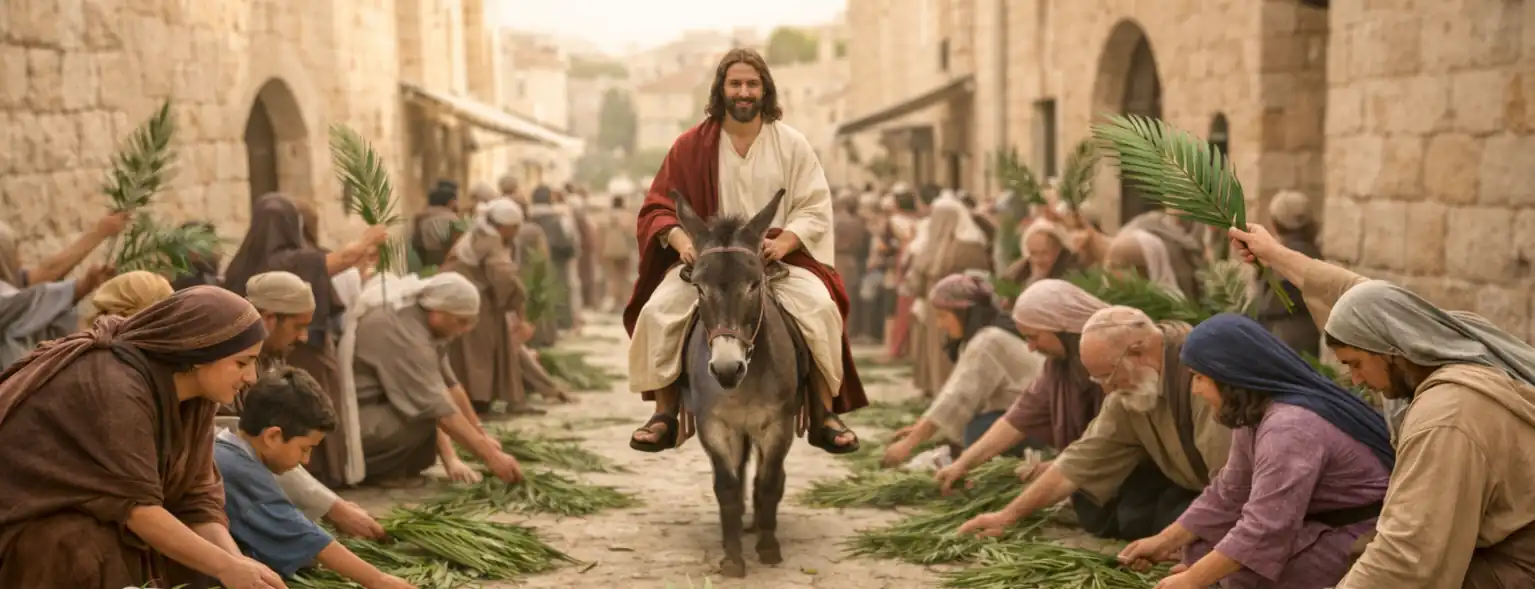
Palm Sunday is far more than a historical moment — it is the public fulfillment of ancient prophecy concerning the coming Messiah. It is a proof that the Bible is the true Word of the one True God. When Jesus entered Jerusalem riding upon a donkey, the crowds cried out and laid palm branches before Him, not realizing they were participating in a divine script written centuries earlier.
The Old Testament had already foretold the manner, meaning, and message of this moment.
1. The Messiah Would Come in Humility — Riding Upon a Donkey
Long before Jesus was born, the prophet Zechariah declared:
“Rejoice greatly, O daughter of Zion; shout, O daughter of Jerusalem: behold, thy King cometh unto thee: he is just, and having salvation; lowly, and riding upon an ass, and upon a colt the foal of an ass.” — Zechariah 9:9 (KJV)
When Jesus entered Jerusalem, He fulfilled this prophecy exactly:
“And Jesus, when he had found a young ass, sat thereon; as it is written…” — John 12:14–15 (KJV)
The Messiah would not arrive on a war horse, but in humility — a King who brings salvation, not conquest.
2. The People Would Recognize Him as the Promised Son of David
As Jesus entered the city, the crowds cried out:
“Hosanna to the Son of David: Blessed is he that cometh in the name of the Lord.” — Matthew 21:9 (KJV)
This was a direct echo of the Messianic Psalm:
“Blessed be he that cometh in the name of the LORD.” — Psalm 118:26 (KJV)
By shouting “Hosanna,” the people were acknowledging Jesus as the long‑awaited descendant of David — the rightful King.
3. The Messiah Would Come to the Temple Suddenly
The prophet Malachi wrote:
“And the Lord, whom ye seek, shall suddenly come to his temple…” — Malachi 3:1 (KJV)
Immediately after entering Jerusalem, Jesus went straight to the temple:
“And Jesus went into the temple of God…” — Matthew 21:12 (KJV)
Palm Sunday was not random. It was the appointed moment when the Lord Himself would come to His house.
4. The Rejected Stone Would Become the Cornerstone
Psalm 118 also contains another prophecy fulfilled during this event:
“The stone which the builders refused is become the head stone of the corner.” — Psalm 118:22 (KJV)
Though the crowds celebrated Him, the religious leaders rejected Him — fulfilling the prophecy that the Messiah would be refused by His own people.
Palm Sunday marks the beginning of that rejection, which would lead to the cross and ultimately to the resurrection.
5. The Messiah Would Bring Peace — Not Political Revolution
Isaiah foretold the nature of the Messiah’s kingdom:
“And the government shall be upon his shoulder… Of the increase of his government and peace there shall be no end.” — Isaiah 9:6–7 (KJV)
Jesus entered Jerusalem not to overthrow Rome, but to bring peace with God through His sacrifice.
The donkey symbolized peace. The palms symbolized victory. The prophecy symbolized God’s plan unfolding perfectly.
Palm Sunday: A Divine Appointment Kept
Every detail of Palm Sunday — the donkey, the shouts of praise, the palms, the journey to the temple — was foretold in Scripture. Jesus did not accidentally fulfill prophecy; He fulfilled it openly, publicly, and perfectly.
Palm Sunday stands as a reminder that:
- Jesus is the promised Messiah
- God keeps His word
- Prophecy is fulfilled in Christ alone
The King has come — just as the prophets said He would.